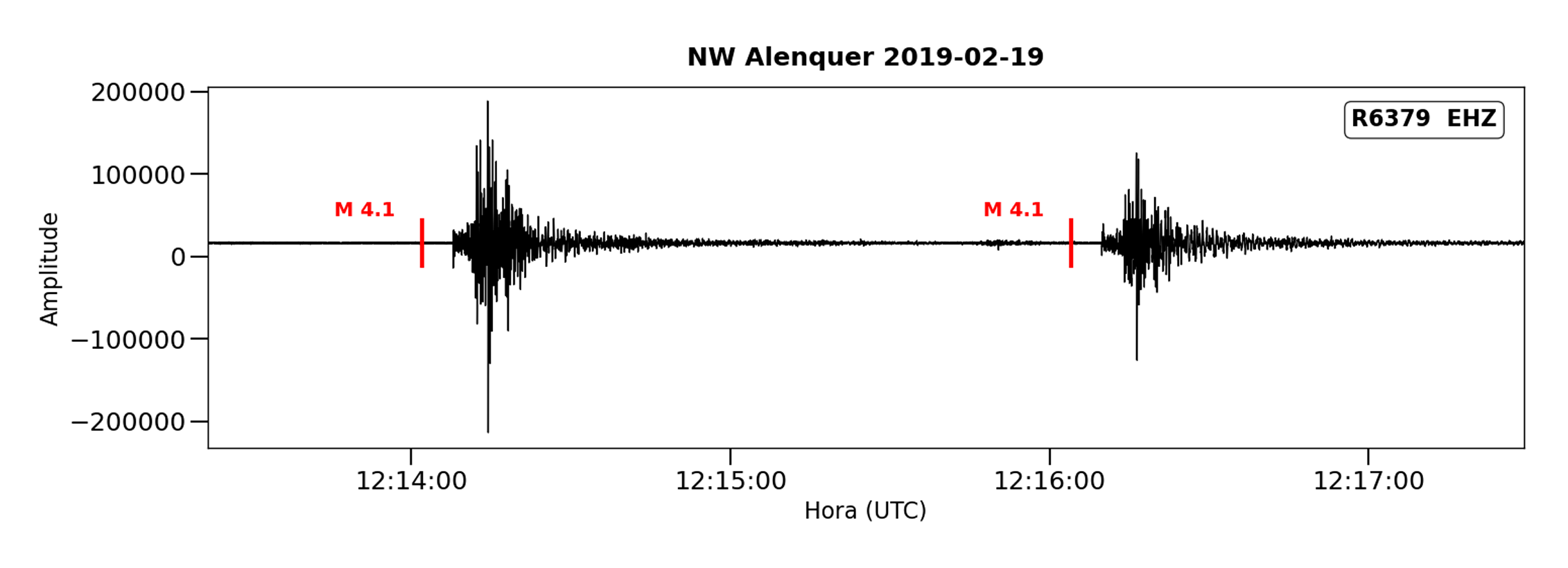
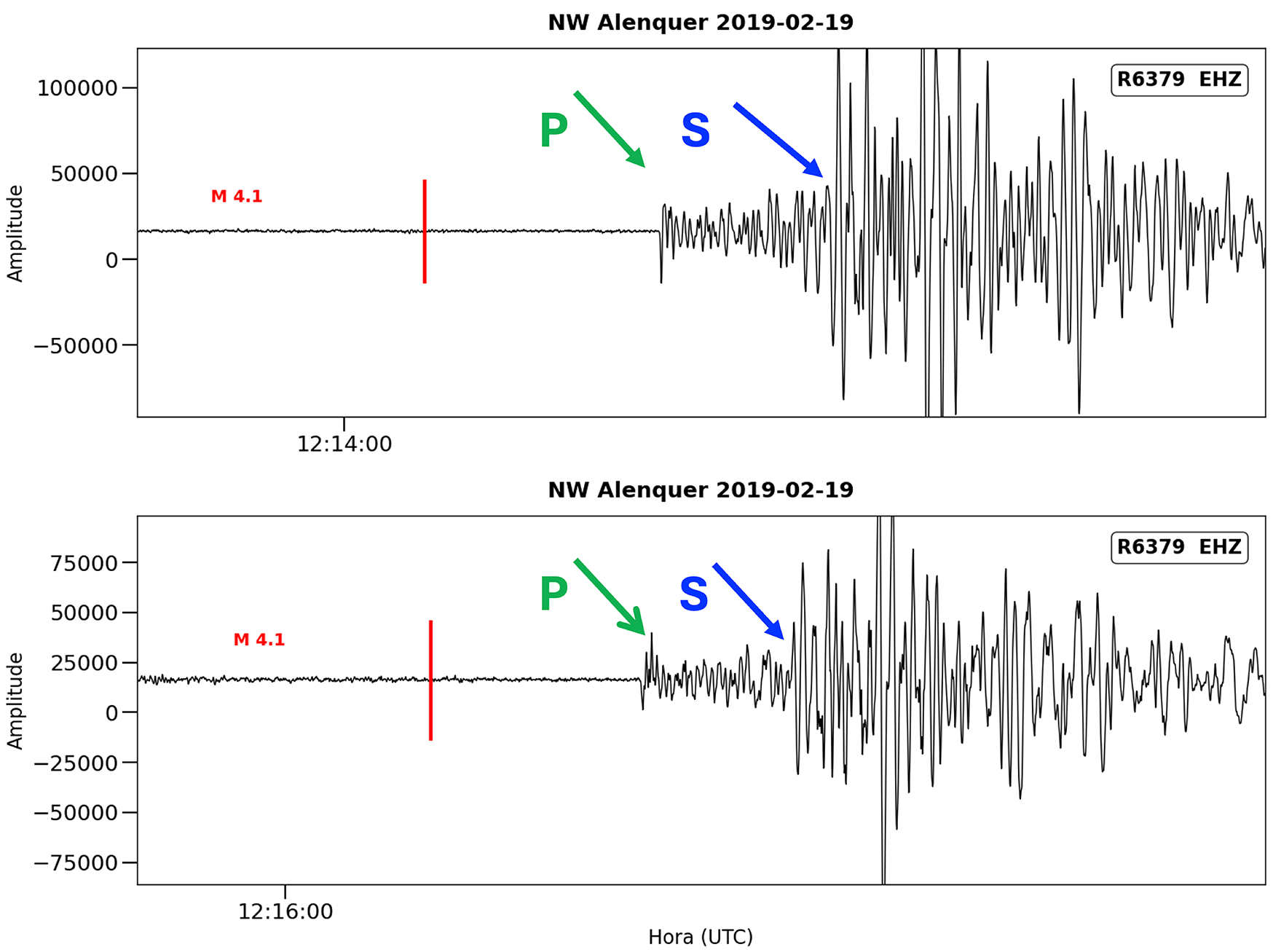
The R6379 seismic station installed on the ISEL campus by the geophysics group of the IDL@ISEL hub once again demonstrated yesterday its importance for monitoring local and regional seismicity. In the early afternoon of February 19, 2026, the station clearly recorded the two earthquakes that occurred in the Alenquer area.
Due to their temporal and spatial proximity and their nearly identical characteristics, these two events can be considered doublet earthquakes, a term used when two earthquakes have very similar magnitudes, virtually coincident epicentres, almost identical waveforms, and occur in sequence, reflecting a common origin and a very similar rupture process.
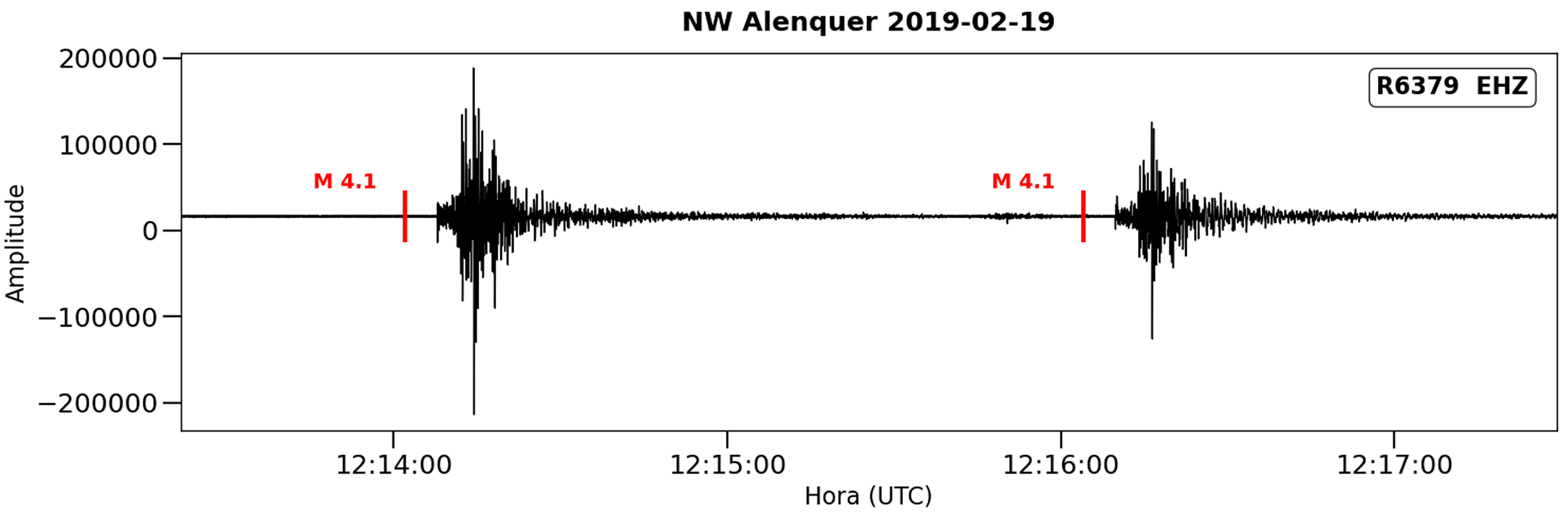
Relative amplitudes are shown on the y‑axis. The red lines mark the event times (12:14:02 for the 1st and 12:16:04 for the 2nd), as computed by the Portuguese Institute for Sea and Atmosphere (IPMA).
The seismic signals were clearly recorded on the three components of the seismometer—vertical, north–south, and east–west—allowing precise identification of the arrival of P and S waves. The sensitivity of the short‑period sensor makes this station particularly effective for recording local or regional earthquakes.
Integrated into the global network Raspberry Shake, which brings together thousands of sensors worldwide, this station enhances seismic monitoring capacity in the Lisbon region and complements the existing network. The recorded data are openly accessible, an approach aligned with the open‑science principles and societal engagement that guide the IDL@ISEL hub. You can consult the station’s earthquake records here.
With this new recording, the station once again establishes itself as a scientific, educational, and civic tool, enabling students, researchers, and the public to follow the region’s seismic activity in real time.
More information about these events is available on the IPMA website in the shakemaps information at this link, and on the EMSC website (1st Earthquake and 2nd Earthquake).
You can view the earthquake records from the ISEL station here.