
No dia 26 de novembro, pelas 14h00, o Departamento de Física do ISEL promove no Auditório A o seminário "Nonlinear Phenomena in Standard and Specialty Optical Fibers Physics and Applications".
O evento terá como orador Mário Ferreira (i3N - Institute of Nanostructures, Nanomodelling and Nanofabrication / Departamento de Física, Universidade de Aveiro).
Abstract:
Nonlinear effects in optical fibers impose different limitations on the communications link, and an understanding of such effects is almost a prerequisite for actual lightwave-system designers. On the other hand, they offer a variety of possibilities for all-optical signal processing, amplification and regeneration.
Using standard optical fibers for these applications, a length of several kilometres is usually required due to their relatively small nonlinear parameter ( ). However, the required fiber length can be significantly reduced using several kinds of specialty optical fibers. For example, it is reduced to about 1km using highly nonlinear silica fibers with a smaller effective mode area, and hence, a larger nonlinear parameter.
A further reduction in fiber length by one order of magnitude has been achieved using nanowires and microstructured optical fibers with an extremely small effective mode area and significantly enhanced nonlinear characteristics. Another main advance was the production of highly nonlinear fibers using materials with a nonlinear refractive index higher than that of the silica glass, namely lead silicate, tellurite, bismuth glasses and chalcogenide glasses. Using such highly nonlinear optical fibers, the required fiber length for all-optical signal processing can be dramatically reduced to the order of centimetres.
This talk provides an overview of such kind of specialty optical fibers, as well as of some novel dispersive and nonlinear phenomena exhibited by them.
The Exploding Soliton(*)
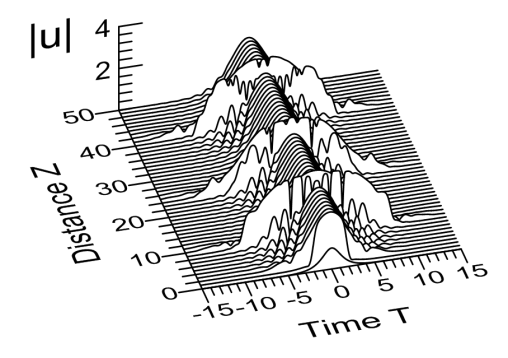
(*) Exploding solitons represent one of the most striking and fascinating nonlinear phenomena which can be observed in nonlinear fiber systems. The soliton explosion manifests itself as a chaotic and quasi-periodic process. The propagating quasi-stable pulse suddenly experiences an abrupt structural collapse, breaking down into multiple pieces. Remarkably, the collapsed pulse can return to its original state even though it experiences strong energy dissipation. The process repeats forever, although the distance between consecutive explosions fluctuates, and in each of them, the pulse splits into different pieces.