

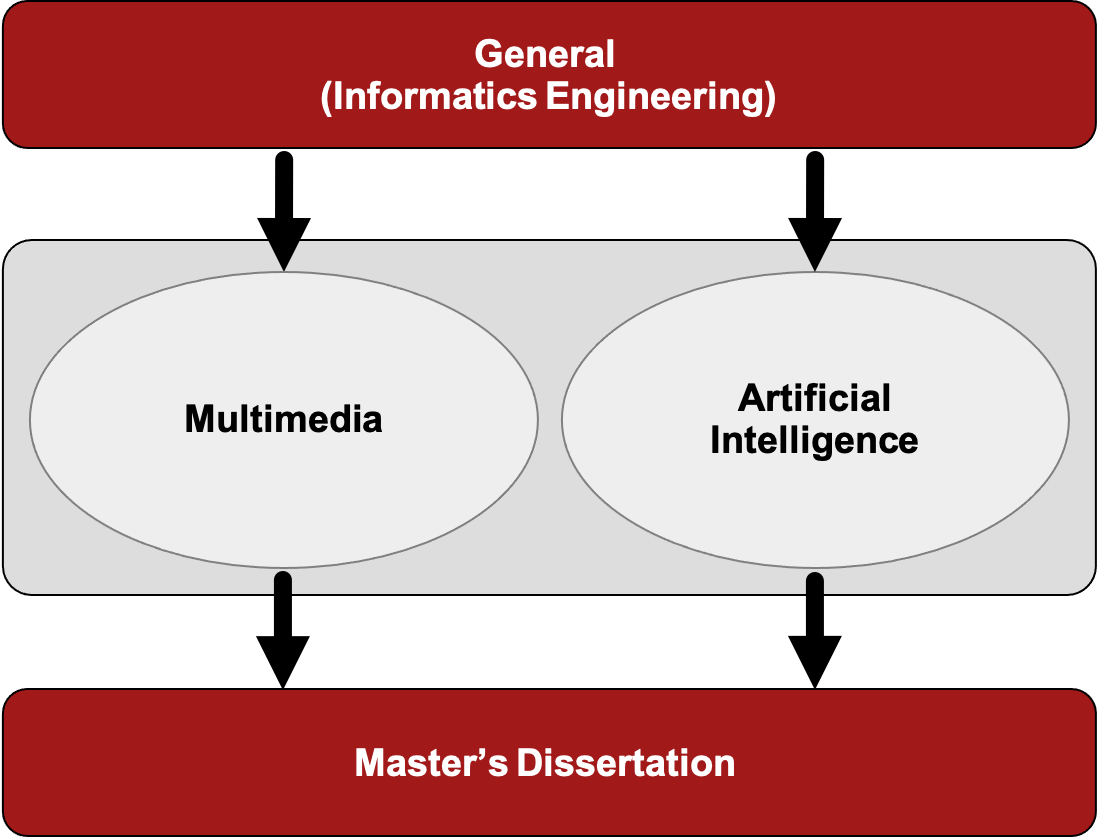
The Master's course in Informatics and Multimedia Engineering (MEIM) has a general formation in Informatics Engineering that supports the specialization area in Multimedia and Artificial Intelligence, which is consolidated in the Final Master's Work (Dissertation, Project or Curricular Internship).
The MEIM course has a high employability of graduates which are well accepted by employers, both nationally and internationally.
Study programme’s generic objectives
The training of highly skilled technical and scientific Engineering professionals, within multimedia systems and technologies in three main areas of expertise:
- Content production
- Analysis and organization of content
- Distribution of content
The skills in these areas of knowledge are central in the context of multimedia systems, having an increasing impact on our society, such as video surveillance, medical applications, geographic information systems, man-machine interaction through not haptic devices, computer games, robotics);
- To provide training where advanced technological and scientific knowledge in the area of multimedia systems and technologies is applied in concrete areas of growing importance in the context of ICT (Information and Communication Technologies);
- To provide an innovative training tailored to market requirements, deeply rooted in the relationship with industry.
The PhD Program in Cyber-Physical Systems for Sustainable Development (CPS-SD) is a four-year doctoral program focused on applied research, placing advanced engineering and emerging technologies at the service of the United Nations 2030 Agenda for Sustainable Development. The program centers on Cyber-Physical Systems (CPS)—intelligent solutions that tightly integrate sensing, computation, communication and control with physical processes. These systems constitute the technological backbone of smart cities, resilient infrastructures, next-generation healthcare, sustainable energy networks and Industry 4.0, enabling real-time interaction between the digital and physical worlds in a human-centred manner.
The program provides a strong interdisciplinary environment, bringing together expertise from Electronics and Telecommunications Engineering, Computer and informatics Engineering, Engineering Physics, and Biomedical Engineering. During the first year, students undertake advanced training covering sustainable development, research methods and ethics, core CPS concepts, and technology management and entrepreneurship. This training is complemented by elective courses that allow students to deepen their knowledge in areas such as communications, photonics and optoelectronics, intelligent and ubiquitous systems, computational systems, climate challenges, materials for CPS, biomedical engineering, and multimedia-oriented CPS applications.
From the second year onwards, students devote themselves fully to original research leading to the doctoral thesis, under the close supervision of experienced researchers.
Throughout the program, students develop advanced research skills, critical thinking and the ability to lead multidisciplinary projects addressing real sustainability challenges. They are also trained to communicate effectively with both scientific and non-specialist audiences and to translate technological innovation into societal impact, including in the context of developing and least-developed countries. Graduates will be well prepared for careers in academia, research institutes, high-technology industries and innovative organizations, contributing to the design and implementation of CPS solutions that directly support the Sustainable Development Goals and help shape a more just, inclusive and sustainable future.